James Hype Edit Pack
From Club DJ to Global Headliner
The Edits, Mashups & Crazy Story Behind His Success
We have collected all his personal Edits into one folder…
Exclusive content, click here to request access.
Who Is James Hype?
James Hype is a British DJ and producer from the Wirral in North West England.
He started DJing as a teenager, initially playing parties before working his way into clubs around Liverpool.
Those early years were important.
Playing regularly to real crowds teaches things that simply can’t be learned from producing tracks in a bedroom:
- When to change direction
- How long to stay on a record
- How to rescue a dance floor
- Which vocals connect instantly
- When a mix needs more energy
- And which tracks sound brilliant at home but simply don’t work in a club
That experience helped shape the performance-heavy DJ style for which he would later become famous.
From Liverpool Clubs To The Bigger Stage
Before the international festivals, viral videos and hit records, Hype spent years doing what working DJs everywhere do.
Playing clubs.
Handing out mixes.
Trying to get bookings.
Learning what works by actually standing behind the decks.
His background in the Liverpool club scene also exposed him heavily to House music.
But his own tastes weren’t limited to House.
Hip-hop, R&B, pop and other genres all interested him.
That created a problem.
How do you play a vocal or song you love inside a House set without completely destroying the flow?
For James Hype, the answer was simple:
Make your own version.
The Edits That Helped Create The James Hype Sound
Long before he was an established producer, Hype was making edits and mashups for his own DJ sets.
Instead of accepting that a Hip-Hop or R&B record couldn’t fit into his House set, he would rebuild it.
Take the vocal.
Add House drums.
Change the arrangement.
Create an intro that could actually be mixed.
Build a drop.
Suddenly a record that didn’t belong in the set…
did.
That approach became one of the foundations of his sound.
For working DJs, this is important.
A DJ edit isn’t simply about making a famous record louder.
A genuinely useful edit solves a problem.
It can turn a great song into a great DJ record.
Why James Hype Uses Personal DJ Edits
One of the reasons a James Hype set feels different is that you aren’t always hearing the same versions available to everybody else.
His sets regularly feature combinations of:
- Personal edits
- Bootlegs
- Acapellas
- Mashups
- Loops
- Unfinished ideas
- Samples
- Alternative drops
That creates exclusivity.
Even when you recognise the vocal, you don’t necessarily know what is about to happen next.
And that is one of the most powerful tools a DJ can have.
If everybody has access to exactly the same music, your selection and technique become the only things separating you.
But if you’ve also created your own versions of those records…
your set starts developing an identity of its own.
Turning Hip-Hop & Pop Into House Weapons
Hype has spoken openly about taking records from outside House music and finding ways to make them playable in his own sets.
That could mean taking an isolated vocal from a Hip-Hop track and rebuilding the record around House drums and a new bassline.
The concept is simple:
Keep the part people recognise. Change everything around it.
For a crowd, that’s incredibly effective.
They hear a familiar vocal.
Recognition kicks in.
Then instead of the version they’re expecting, the record drops into something designed specifically for a club system.
That’s exactly why good edits and mashups can create such huge reactions.
The Rise Of “More Than Friends”
James Hype’s career moved into another gear with the release of More Than Friends.
Built around a familiar vocal reference but reshaped into a modern House record, the track became a major crossover success.
It demonstrated something Hype had already been doing behind the decks for years:
Take something recognisable and give it a completely different context.
The record helped introduce James Hype to an audience far beyond the UK club circuit.
But he didn’t stop being a DJ once the productions became successful.
If anything, the DJ performances became an even bigger part of the brand.
Ferrari Takes James Hype Global
Then came Ferrari.
The record became an international hit and pushed James Hype into another level of mainstream recognition.
Suddenly the same DJ who had spent years developing routines in clubs was appearing on the biggest festival stages around the world.
For many producers, a crossover hit can result in the DJing becoming simpler.
Hype went in the opposite direction.
The bigger the stages became, the more emphasis he placed on performance.
What Does “Real DJing” Mean?
James Hype has become closely associated with the phrase Real DJing.
The idea isn’t that DJs need to perform endless tricks to be legitimate.
It’s about treating DJing as a skill worth practising.
Reading a crowd.
Taking risks.
Understanding your equipment.
Learning how records fit together.
Creating new combinations live.
And not allowing the technology to make the DJ passive.
That attitude has resonated strongly with younger DJs because it makes the decks themselves exciting again.
You’re not simply watching somebody play records.
You’re watching somebody manipulate them.
Four Decks, Loops, Acapellas & Live Mashups
A typical James Hype performance can become extremely busy.
Multiple decks allow him to separate different elements of a mix.
One deck might provide the main instrumental.
Another could contain an acapella.
A third might introduce a loop.
A fourth could be prepared with the next record.
That gives him the ability to create combinations that don’t necessarily exist as finished tracks.
In other words, part of the remix can happen live.
That blurs the distinction between DJing and production.
Preparation Doesn’t Mean A Set Isn’t Live
One interesting part of Hype’s approach is the balance between preparation and improvisation.
Complex routines require practice.
If you’re planning to execute a multi-deck transition involving several hot cues, loops and acapellas in front of thousands of people, you probably don’t want the first attempt to happen live on stage.
But that doesn’t mean every performance is identical.
Ideas can start spontaneously.
They get tested.
Adjusted.
Improved.
And eventually become routines that audiences associate with the DJ.
It’s very similar to how bands rehearse songs before performing them live.
Preparation gives you the confidence to take more risks.
Why Personal Edits Matter To Working DJs
You don’t need four decks and a festival crowd to learn something from James Hype’s approach.
The bigger lesson is extremely relevant to any working DJ:
Build versions of records that work for your sets.
Imagine you love a song but:
- The intro is too short
- The breakdown kills the energy
- The original drums sound weak
- The vocal works but the production doesn’t
- There’s no usable outro
- The best part arrives too late
An edit can fix those problems.
Even something as simple as adding a 16 or 32-bar intro can transform how useful a record becomes.
Familiar Music, Unfamiliar Versions
Some of the biggest reactions in DJ sets happen when a crowd recognises something…
but doesn’t recognise the version.
That’s the sweet spot.
Think of artists such as:
- Sean Paul
- Drake
- The Killers
- Da Hool
- Michael Jackson
- Rihanna
- Beyoncé
- Classic House artists
- Hip-Hop favourites
- 2000s Pop records
A strong House edit gives a DJ access to the emotional connection of the original while maintaining the energy and sonic consistency of a club set.
Why DJ Edits Are More Important Than Ever
Modern DJs have access to more music than at any point in history.
That’s brilliant.
But it creates another problem.
Everybody has access to the same music.
Beatport.
Spotify.
SoundCloud.
Record pools.
Promo lists.
Social media IDs.
The advantage is no longer simply finding the record.
Increasingly, the advantage is finding the version.
The edit nobody else has.
The mashup that makes people look at the booth.
The remix that lets you play an unexpected vocal without completely changing direction.
That’s where DJ edits become part of your identity.
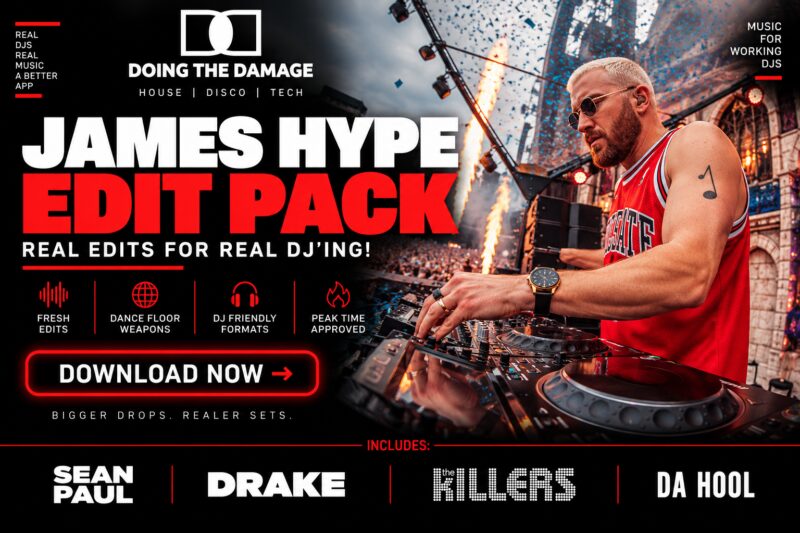
James Hype Edit Pack
At Doing The Damage, we’ve put together a selection inspired by exactly that philosophy:
Real edits for real DJing.
Fresh versions of recognisable records that are designed to actually work behind the decks.
The James Hype Edit Pack includes edits featuring music from artists such as:
- Sean Paul
- Drake
- The Killers
- Da Hool
alongside club-focused versions, mashups and DJ tools designed to give working DJs more options in their sets.
What Makes A Good DJ Edit?
The best edit shouldn’t exist simply because somebody can make one.
It should improve the usefulness of the record.
Look for:
- Clean 16 or 32-bar intros
- Mixable outros
- Stronger drums
- Club-ready low end
- Better arrangement
- Familiar hooks
- Unexpected combinations
- Drops that work on a real system
- Enough of the original identity to trigger recognition
The result should make you think:
“That’s the version I want to play.”
James Hype’s Biggest Influence Might Be On DJs
Hit records like Ferrari introduced James Hype to millions of listeners.
But his longer-term influence may ultimately come from somewhere else.
He has helped make technical DJing visible again.
A generation of young DJs now watches transitions, learns routines, experiments with four decks and thinks about how they can manipulate music rather than simply play it.
More importantly, he’s reinforced an idea that DJs understood long before social media existed:
Your version of a record can matter just as much as the record itself.
At Doing The Damage, you’ll find thousands of exclusive House, Disco and Tech edits, mashups and remixes created for working DJs.
Members get access to:
- 10,000+ exclusive DJ edits
- Unlimited downloads
- Fresh music added regularly
- Instant previews
- BPM and key information
- Mashups and bootlegs
- Classic tracks reworked for modern dance floors
- DJ-friendly intros and arrangements
- House, Disco, Tech and crossover edits
Because having the right track is good.
Having the right version is better.